
Jan 22, 2026
7 min read
One comment I've heard a lot is that batteries degrade quicker than internal combustion engines do. Most will acknowledge that even the best maintained ICE engine will lose horsepower over time, thus causing it to consume more fuel to do the same job that it used to. But then I always hear about a 'cliff' that drops with batteries. But, my brother currently owns my first Tesla Model 3, from 2019. It's running beautifully and has a 70th percentile battery capacity. Despite, because of his home situation, being mostly charged on rapid chargers (possibly the quickest way to degrade a battery packs life).
So, with the help of an artificial friend, I did some research to prove a hypothesis. The hypothesis is that battery degradation is real, but it is not linear. In fact, the longer lasting a battery, the lower the degradation is over time. And this is true across vehicle, domestic and commercial use.
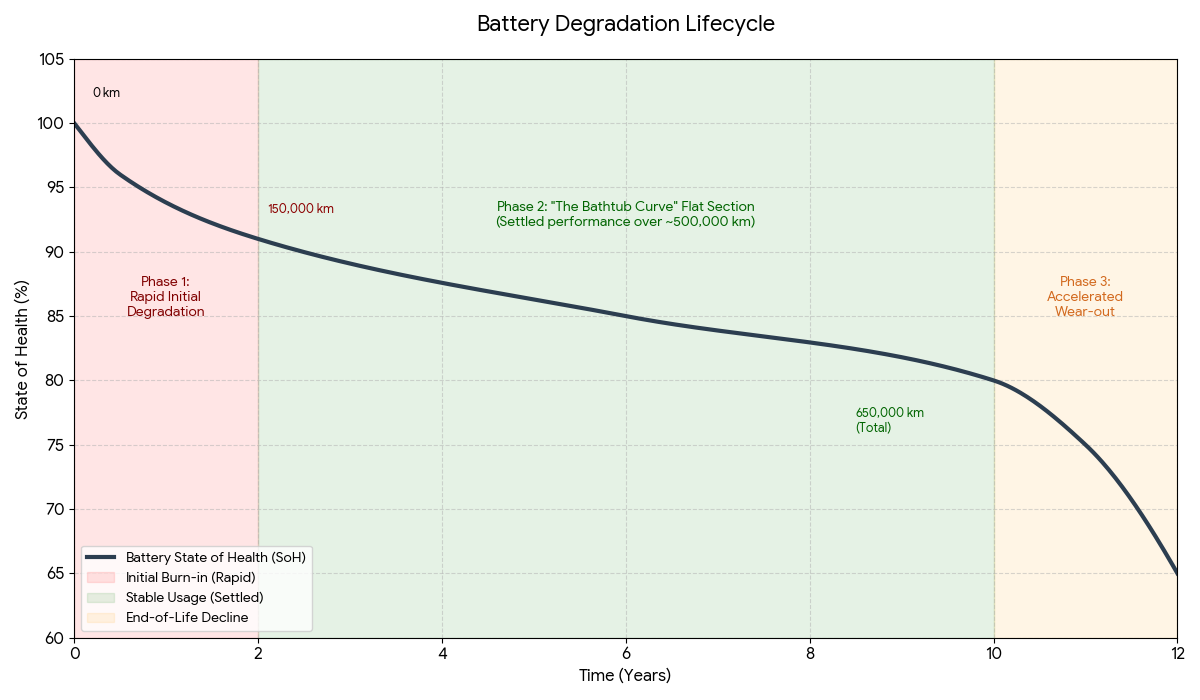
One of the underappreciated characteristics of modern lithium-ion batteries is their degradation pattern. Rather than declining at a constant rate, batteries follow a characteristic curve. It starts with a relatively steep initial degradation followed by a prolonged period of slow, stable decline.
What the Research Shows
Geotab's comprehensive 2024-2025 study, analysing telematics data from over 22,000 EVs across 21 different models, found that modern EV batteries degrade at an average rate of just 1.8% to 2.3% per year. The study concluded that "as a general rule, EV battery life is expected to decline non-linearly: an initial drop, which continues to decline but at a far more moderate pace" (Geotab, EV Battery Health Insights, 2025).
Tesla's reports corroborate this. Model 3 and Model Y Long Range vehicles showed an average battery capacity loss of only 15% after 200,000 miles, while Model S and Model X vehicles demonstrated 12% capacity retention at the same mileage. What's particularly notable is the shape of this curve: approximately 10% of degradation occurs within the first 95,000-130,000 kilometres, after which the rate of decline slows considerably, taking another 200,000-250,000 kms for the remaining 5% of degradation to occur. Worth noting that most manufacturers guarantee their batteries for the first 100,000 kms or so.
As Recurrent Auto's battery research team explains, "when a battery is new, there can be some noticeable degradation as the battery settles into its steady state. After that, there is a long period of slow, linear aging, followed by a sharp decrease when the battery dies" (How Long Do Electric Car Batteries Last, 2025). For the vast majority of vehicle lifespans, batteries remain in that stable "middle" phase.
The Science Behind the Curve
This S-curve degradation pattern is rooted in battery chemistry. During initial use, lithium salts react with other materials to form the solid-electrolyte interphase (SEI) layer on the anode. Once this layer stabilizes, typically within the first year or 30,000 kms, the rate of degradation slows dramatically. According to research published in the journal Batteries (MDPI, 2022), this phenomenon has been extensively documented in laboratory testing of commercial EV batteries, where "a non-linear degradation model with calendar and cyclic aging" consistently demonstrates this characteristic behavior.
Internal Combustion Engines: A Different Story
In stark contrast to the improving-with-age characteristics of battery systems, internal combustion engines face an inexorable decline in efficiency that accelerates with mileage.
Progressive Efficiency Loss
A 2022 study published in Energies (MDPI) specifically examined "Energy Losses Related to Ring Pack Wear in Gasoline Car Engine" and found that engine wear corresponding to 300,000 kms of car mileage results in increased fuel consumption of 1% to nearly 4%, depending on operating load. The study noted that this wear "is assumed to be linear." This suggests that it continues progressively rather than stabilising.
The mechanics of this decline are straightforward. Pistons, rings, and cylinder walls wear causing compression losses to increase. Gas leakage past worn rings reduces the energy captured from each combustion cycle. The study documented that "engine wear leads to reduced efficiency and increased emissions." A double penalty for aging ICE vehicles.
Inherent Inefficiency Compounds the Problem
Even a new internal combustion engine operates at a significant disadvantage. According to the U.S. Department of Energy, only 12% to 30% of the energy in gasoline actually moves the vehicle down the road. The remaining 70-88% is lost to heat through the radiator and exhaust (58-62%), friction (3%), pumping losses (4%), drivetrain losses (5-6%), and "parasitic loads" (4-6%).
As engines age, these losses compound. Worn components increase friction. Degraded seals allow greater blow-by. Fuel injection systems lose precision—research from ResearchGate documented that gasoline injectors degrade from approximately 0.5% irregularity when new to 6% when heavily worn, directly impacting combustion efficiency and emissions.
The key distinction is this: while a well-maintained ICE can be somewhat restored during overhauls, as noted by Wärtsilä's engineering documentation, the underlying trend remains one of continuous decline requiring ongoing intervention to maintain baseline performance.
If we were to start again, we would never start with ICE to propel ourselves in cars, buses, etc.
Serviceability: The Modular Advantage
When battery capacity does eventually decline beyond acceptable thresholds, the repair pathway offers distinct advantages over traditional powertrain servicing.
EV, commercial and domestic batteries are constructed from modules containing individual cells. Research from Autocraft Solutions Group, which has repaired thousands of EV battery packs, reveals that 92% of modules within failed in-warranty battery packs remain functional. Their data shows that restoring battery packs to optimal condition requires replacing just 1.1 modules on average—not the entire pack.
As a 2025 paper in the World Journal of Advanced Research and Reviews ("Modular Battery Pack Design and Serviceability in Electric Vehicles") explains: "Incorporating diagnostics, safe access mechanisms, and part-level replaceability at the design stage leads to lower warranty claims, improved brand loyalty, and long-term operational efficiency."
Obviously an internal combustion engine has a litany of replaceable parts too. But, the contrast is that engines and gearboxes have interconnected systems, rather than truly modular systems.
Environmental Impact of Repair vs. Replace
The sustainability implications are substantial. According to Autocraft's analysis, producing an 82.5 kWh battery pack emits approximately 11,600 kg of CO₂, with recycling adding another 1,400 kg. In contrast, repairing a battery with a single remanufactured module emits only 951 kg of CO₂—a 93% reduction in emissions per restored pack.
The Renewable Integration Advantage
The most fundamental distinction between battery and combustion technologies lies in their relationship to energy sources.
Battery electric vehicles, home and commercial solutions backed by battery storage can achieve cleaner operation as the electrical grid decarbonises. Research published in Wiley's Energy Science & Engineering (2025) examining the integration of solar PV with EV charging infrastructure notes that "the overall lifecycle emissions of EVs can be reduced, potentially reaching near zero, when the electricity source is derived from non-emitting sources such as wind, hydro, or nuclear power."
When I look at my own cars over the last few years (all EVs), we've been capable of running them for free for significant windows of time through the year thanks to the solar panels on our roof feeding the car when there's excess. Note that I live in Ireland, which has significantly less solar generation capability than countries south of us.
A comprehensive review in Renewable and Sustainable Energy Reviews (ScienceDirect, 2023) documented that the U.S. Department of Energy estimates EVs "may effectively use 60% of the input energy while driving, twice as much as traditional fossil fuel-based vehicles." When that energy comes from renewables, the efficiency advantage compounds with the emissions advantage. That is to contrast against my earlier point that combustion power sources lose enormous amounts of their inherent power to heat loss, while batteries do not. And batteries can be powered by sustainable efforts. While combustion engines can not.
Again, with the technology of the day, if we were to start again, we would never start with ICE.
Conclusion: The Long-Term Calculus
Battery systems begin with a predictable period of settling-in degradation, then stabilize for the majority of their operational life. Internal combustion engines, conversely, suffer continuous wear-related efficiency losses that compound over time. I would also suggest without much research that combustion engine quality can vary quite a lot, and that the average engine in-use is relatively poor quality and thus probably degrades more. Whereas batteries are subject to chemistry, and therefore on average perform the same, regardless of what logo adorns the box.
When maintenance is required, batteries offer modular, targeted replacement options that restore function while preserving the vast majority of healthy cells. And fundamentally, only battery electric vehicles can take advantage of the ongoing decarbonisation of electrical grids.
As Geotab's research concludes: "With these higher levels of sustained health, batteries in the latest EV models will comfortably outlast the usable life of the vehicle and will likely not need to be replaced." The same cannot be said of the pistons, rings, and bearings in any internal combustion engine ever built.
Sources Cited
Tesla Impact Reports:
- Tesla 2023 Impact Report coverage - InsideEVs analysis
- Tesla 2022 Impact Report coverage - InsideEVs analysis
Battery Degradation Research:
- Recurrent Auto: How Long Do Electric Car Batteries Last?
- MDPI Batteries: Degradation Characteristics of Commercial Li(NiMnCo)O₂ EV Batteries under V2G Services
- Battery University: Battery Aging in an Electric Vehicle
- Sustainability by Numbers: How Much Do Electric Car Batteries Degrade?
ICE Efficiency & Degradation:
- MDPI Energies: Energy Losses Related to Ring Pack Wear in Gasoline Car Engine
- Green Car Reports: DOE Fact - ICE Cars Waste 70-88% of Energy
- Wikipedia: Engine Efficiency
- DieselNet: Engine Efficiency Technical Overview
- Wärtsilä: Evaluating Internal Combustion Engine Performance
Battery Serviceability & Repair:
- Autocraft Solutions Group: Challenging Four Myths Around EV Battery Repair
- Autocraft Solutions Group: How Does Sustainable EV Battery Repair Work?
- Battery Tech Online: EV Battery Remanufacturing Cuts Costs & Emissions
- World Journal of Advanced Research and Reviews: Modular Battery Pack Design and Serviceability (PDF)
- Canary Media: EV Battery Repair is Dangerous—But Some Mechanics Want to Do It
Renewable Energy Integration:
- ScienceDirect: The Future of Green Mobility - Renewable Energy Systems Integration in EVs
- Frontiers in Energy Research: Grid-integrated Solutions for Sustainable EV Charging
- ScienceDirect: Renewable Energy Integration with EV Technology - Smart Charging Review
- Wiley Energy Science & Engineering: Integration of Solar PV Panels in EV Charging Infrastructure
- Nature npj Sustainable Mobility: Optimization of Electric Charging Infrastructure
- MDPI World Electric Vehicle Journal: EVs and Renewable Energy Distributed Generation in Smart Grids
- Nature Scientific Reports: Economic Energy Optimization in Microgrid with PV/Wind/Battery and EV Charging
- EV Battery Health Insights: Data From 10,000 Cars (2024)
- 2024 Battery Degradation Update Press Release